
GRP Sectional Water Tanks
Tricel manufactures GRP sectional water storage tanks for commercial, industrial and building-services projects throughout Ireland. Built from modular GRP panels and assembled on site, sectional tanks suit locations with restricted access where a complete one-piece tank cannot be delivered. Capacities range from 1,000 litres to over 4 million litres using Tricel’s current metric panel system, with potable and non-potable configurations, insulated Format 30 options and bespoke dimensions available to suit individual plant-room layouts.
01
What Are GRP Sectional Water Storage Tanks?
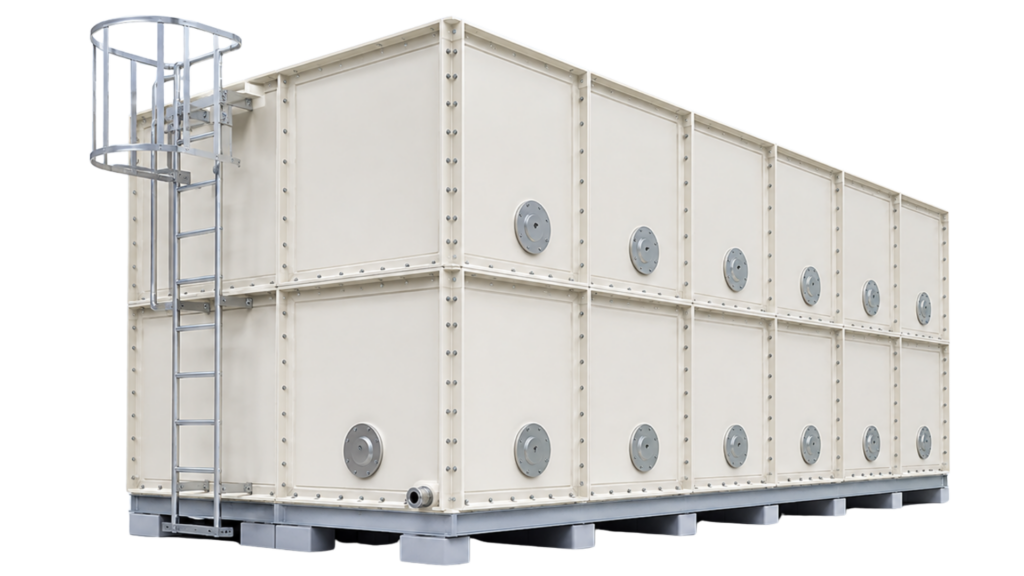
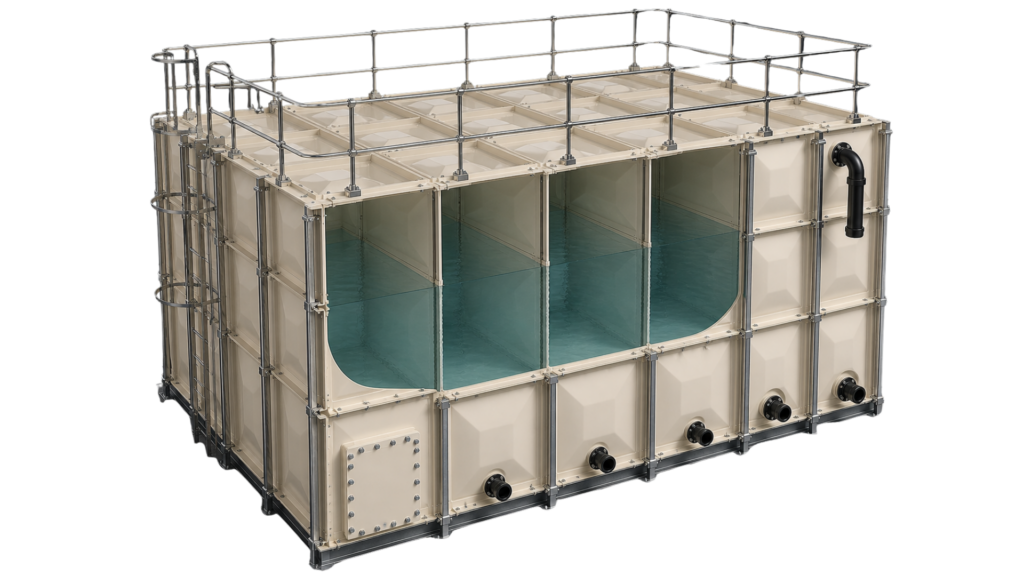
A sectional water tank is a GRP cold water storage tank built from individual moulded panels that are transported to site and bolted together to form the finished structure. Sectional tanks support significantly larger capacities than factory-assembled one-piece tanks and are particularly suited to plant rooms with restricted access, as panels, rather than a complete vessel, can be carried into position and assembled in situ. Length, width, and height can be configured in panel increments, while internal partitions can divide the stored volume. Different base and flange configurations also allow the tank to be adapted to plant room conditions and available headroom. Sectional tanks are not automatically better or more economical than one-piece tanks; the right choice depends on the required capacity, site access, and project requirements, which are discussed further in the one-piece tank comparison below.
In Ireland, sectional GRP tanks are commonly installed in basement plant rooms, roof-level tank rooms, and service voids within commercial, healthcare, pharmaceutical, hospitality, and public-sector buildings. Their ability to be assembled in confined spaces, and in some cases reconfigured or extended as requirements change, makes them a frequently specified solution for large-volume cold water storage where site access is constrained.
GRP Sectional Tank - Key Parameters
Construction
Modular GRP sectional panel tank
Material
Glass-Reinforced Plastic (GRP)
Capacity Range
1,000 litres to over 4 million litres
Panel Sizes
1,000 × 1,000 mm; 1,000 × 500 mm; 500 × 500 mm
Maximum published height
Up to 4 m with the current metric panel system
Insulation
Format 30 options available
Base options
Internally or externally flanged base configurations
Restricted access
Internally flanged and True TIF options available
Installation
Panels delivered individually and assembled on site
02
GRP Sectional Tank Specifications for potable and non-potable water
The table below sets out the principal technical parameters for Tricel GRP sectional water storage tanks. Specifiers should confirm the exact configuration required — including panel dimensions, inlet and outlet positions, access cover locations, and structural base requirements — at the time of enquiry.
|
Specification
|
Details
|
|---|---|
|
Construction method
|
Modular GRP panels assembled and bolted on site
|
|
Panel Material
|
Glass-reinforced plastic (GRP)
|
|
Capacity range
|
1,000 litres to over 4 million litres
|
|
Metric panel sizes
|
1,000 × 1,000 mm; 1,000 × 500 mm; 500 × 500 mm
|
|
Maximum metric height
|
Up to 4 m in the current published brochure
|
|
Tank increments
|
Half-panel increments available
|
|
Insulation
|
Format 30 insulated options available
|
|
Base types
|
Internally flanged or externally flanged
|
|
Restricted-access options
|
Internally flanged and True TIF configurations
|
|
Access ladders
|
Internal/external options subject to tank height and specification
|
|
Guardrails
|
Available where required
|
|
Side access
|
Side-access hatch options available
|
|
Fittings
|
Inlet, outlet, overflow, warning pipe and drain arrangements are project-specific
|
|
Installation
|
Site assembly by trained personnel
|
|
Manufacturing quality
|
ISO 9001 quality-management system
|
Specification note
Final tank capacity, nominal dimensions, panel configuration, base arrangement, insulation, fittings, access requirements, support structure and maintenance clearances must be confirmed against the current Tricel drawings and project specification before manufacture.
03
BENEFITS OF SECTIONAL TANKS
The principal reason GRP sectional tanks are specified for commercial and industrial projects in Ireland is their ability to be assembled inside an existing building, regardless of the size of the access route. The following points set out the main practical advantages of this construction type, based on the characteristics of the product.
restricted access
Individual panels can be transported through constrained plant-room access routes, corridors and doorways, and assembled in position, removing the delivery bottleneck that a single large factory-built tank would face.
Large capacity range
Sectional construction supports storage from approximately 1,000 litres to more than 4 million litres, covering both modest plant-room duties and large-scale commercial or industrial storage within a single construction method.
Corrosion Resistance
GRP does not rust, which suits long-term water-storage applications in plant rooms and external locations. See Material, Durability and Warranty for further detail on this property.
Flexible Dimensions
Length, width and height can be configured around available plant space using the standard metric panel increments, rather than being limited to a fixed set of factory-moulded sizes.
Potable and Non-Potable Options
Tank configurations are available for both drinking-water and non-potable duties, allowing the same panel system to be specified across break tanks, header tanks and process-water storage.
Internal Dividers
Partitions can provide separate compartments within a single tank shell, useful where a facility needs to isolate part of its stored volume for cleaning or maintenance without losing full-capacity supply.
Format 30 Insulation
Insulated tank configurations are available with heavy-duty covers and insulated roof and side panels, for projects where the stored water needs additional thermal protection.
Multiple Base Configurations
Internally and externally flanged tank designs allow the structure to suit different plant-room and support conditions, from elevated steel supports to flat foundations with restricted headroom.
04
Applications and Industries Served
GRP sectional water storage tanks are specified across a range of commercial, institutional and industrial sectors in Ireland, wherever cold water storage capacity, potable or non-potable, is required as part of the building services or process design.
Healthcare
Potable and non-potable water storage for hospitals, clinics and healthcare estates, including divided-tank configurations to support continuity of supply during maintenance.
Commercial Buildings
Cold-water storage for offices, retail developments and mixed-use buildings, sized to project demand rather than a single standard capacity.
Hotels & Hospitality
Large-volume water storage for hotels and accommodation developments, where peak demand and guest-facing continuity of supply are key considerations.
Education
Water storage for schools, colleges, universities and campus facilities, often installed or replaced within existing plant-room footprints during term-time works.
Data Centres
Large-capacity cold-water storage for critical facilities where plant-space efficiency and resilience of supply are important design considerations.
Pharmaceutical & Life Sciences
Project-specific water storage for pharmaceutical and other controlled commercial environments, specified against the water-quality and configuration requirements of the individual site.
Industrial & Manufacturing
High-volume storage for building-services and process-related applications, including non-potable process water alongside standard cold-water storage duties.
Public Sector & Utilities
Sectional tanks for government facilities, municipal services and infrastructure projects, where large capacities and restricted-access installation are frequently both relevant.
05
GRP SECTIONAL WATER TANK RANGE
Tricel offers a number of sectional tank configurations built from the same GRP panel system, selected according to base conditions, access restrictions, water type and whether the stored volume needs to be divided.
STANDARD CONFIGURATION
Standard Sectional Tank
The standard configuration uses an internally flanged base with externally flanged side walls and stainless-steel underwater stays, suited to sites with normal plant-room access and a level base or support structure.
ELEVATED SUPPORT / BASE ACCESS
Externally Flanged Base Tank
An externally flanged base (EFB) tank is designed for positioning on elevated supports, allowing access beneath the tank for pipework joints and connections during installation and maintenance.
RESTRICTED HEADROOM
Internally Flanged Base Tank
An internally flanged base (IFB) tank is designed for flat foundations or levelled steel beams and is useful where available headroom beneath the tank is restricted.
LIMITED PLANT-ROOM SPACE
Internally Flanged (IF) Tank
An internally flanged tank is built around project-specific plant-room conditions to maximise usable floor space where wall-to-wall clearance is limited.
HIGHLY RESTRICTED ACCESS
True Totally Internally Flanged (True TIFF)
The True Totally Internally Flanged (True TIFF) configuration is intended for highly restricted installations, including positioning close to walls where external assembly clearance would otherwise be insufficient.
POTABLE / INSULATED STORAGE
Format 30 Insulated Tank
The Format 30 configuration combines a heavy-duty cover with screened vents and overflow arrangements and insulated roof and side panels, for potable-water storage duties where insulation is appropriate to the installation.
COMPARTMENTALISED STORAGE
Divided Tank
Internal partitions are available where a project requires separate compartments within a single tank shell, for example to allow one compartment to be taken out of service without losing the full stored volume.
BESPOKE FOOTPRINT
Bespoke / L-Shaped Tank
Rectangular, square and L-shaped configurations are available for difficult installation conditions where a standard rectangular footprint does not suit the available plant-room space.
06
CATEGORY 5 GRP SECTIONAL BREAK TANKS
A GRP sectional break tank provides a physical air gap between the incoming mains water supply and a downstream system, helping prevent contaminated water from flowing back into the public water network. Sectional construction is particularly suited to larger-capacity break tank installations, commercial plant rooms, and projects where access or available space requires a modular water storage system. Tricel sectional tanks can be configured to suit project-specific capacity and site requirements.
Purpose
what a sectional tank does
A sectional break tank separates the public water supply from the downstream water system by means of an appropriate air gap. This prevents downstream water from being drawn or forced back towards the mains under backflow conditions, while providing larger-volume GRP water storage where required.
Typical Applications
Where sectional Break tanks are specified
GRP sectional break tanks are typically specified where higher water storage capacities or greater backflow protection are required, including commercial buildings, industrial facilities, wastewater sites, process-water systems, booster pump installations, and other applications where the potable mains supply must be separated from the downstream system.
Compliance & Regulations
FLUID CATEGORY 5 PROTECTION
Fluid Category 5 represents the highest level of contamination risk under the EN 1717 classification system. Where a Fluid Category 5 risk exists, an appropriate physical air gap is generally required between the potable water supply and the downstream system. The required air-gap arrangement must be determined for the specific installation.
The fluid category and air-gap terminology referenced above is based on I.S. EN 1717, the Irish adoption of the European standard for protection against contamination of potable water systems by backflow. Uisce Éireann guidance identifies AA or AB air-gap arrangements for certain higher-risk applications.
The required level of backflow protection, tank configuration, effective storage capacity, and air-gap arrangement should be confirmed with Uisce Éireann, the project designer, or the relevant consulting engineer before specifying a GRP sectional break tank.
07
Installing a GRP SECTIONAL TANK
Installing a GRP sectional water tank requires a suitable base or support structure, a confirmed access route with adequate assembly clearance, and on-site panel assembly by trained personnel; exact requirements vary by tank configuration and must be checked against Tricel’s current drawings before construction begins.
|
Requirement
|
Guidance
|
|---|---|
|
Site survey
|
Confirm room dimensions, access route and assembly space before tank selection is finalised.
|
|
Tank selection
|
Confirm capacity, base type and panel configuration against the project specification.
|
|
Structural support
|
Provide a base or support structure in accordance with Tricel's requirements for the selected configuration.
|
|
Base levelling
|
Use a suitable level support; Tricel base levelling steels are available for applicable installations.
|
|
Assembly clearance
|
Allow the clearances required for the selected tank configuration around all sides and above the tank.
|
|
Panel assembly
|
Panels are assembled, bolted and sealed on site by trained personnel.
|
|
Fittings
|
Coordinate inlet, outlet, overflow, warning-pipe and drain positions with the M&E design.
|
|
Internal access
|
Confirm manways, internal ladders and compartment access required for inspection and cleaning.
|
|
External access
|
Confirm external ladders, cages or guardrails where tank height or site risk assessment requires them.
|
|
Filling
|
Inspect the completed tank and supervise first filling before handover.
|
|
Commissioning
|
Commission and maintain the tank in accordance with current Tricel guidance and the applicable project requirements.
|
Installation Note
The supporting base, clearance dimensions and access requirements differ by tank configuration. Always use the current Tricel installation and clearance drawings for the specific tank being installed — see Tank Installation and Tank Support & Clearance Requirements for the detailed guidance behind this summary.
Where installation involves confined-space entry, working at height or manual handling of panels on site, the works should be planned and risk-assessed in line with general site safety guidance published by the Health and Safety Authority (HSA).
08
Compliance for GRP SECTIONAL Tanks in Ireland
Tricel manufactures its sectional water tanks under an ISO 9001 quality-management system, and uses WRAS-approved materials in relevant potable-water configurations; the wider compliance position for a given installation depends on the applicable water-hygiene, building-control and fire-authority requirements set for that specific project, not on the tank alone.
|
Instrument
|
Description
|
|---|---|
|
ISO 9001
|
Tricel operates to an ISO 9001 quality-management system across its manufacturing operations, covering the production of GRP sectional tank panels and components.
|
|
Potable-water applications
|
Tricel states that its sectional tanks are suitable for potable-water storage. Where WRAS approval is referenced, it applies to the specific materials and configurations used in contact with drinking water — it is a UK-run materials approval scheme referenced by Irish specifiers for water-fittings hygiene, not an Irish statutory requirement. Confirm the WRAS scope for the exact tank configuration specified before relying on it in a tender. Public drinking-water supply and connection matters in Ireland fall under Uisce Éireann; where a sectional tank forms part of a potable-water storage system fed from the public network, the connection and any related requirements should be confirmed with Uisce Éireann and the project's water-hygiene consultant, not assumed from this page.
|
|
Format 30
|
Format 30 is Tricel's own specification for an insulated sectional tank, incorporating a heavy-duty cover, screened vents and overflow arrangements, and insulated roof and side panels. Format 30 is a Tricel product specification, not an Irish statutory certification, and specifying it does not by itself guarantee compliance with every applicable Irish potable-water requirement — the complete installation still needs to be assessed against the project's own water-hygiene and building-control requirements.
|
|
Water-system design
|
The complete water-storage and distribution installation — pipework, valves, level controls, pumps and the tank itself — must be designed and maintained to the water-hygiene and building-services requirements applicable to the project. A compliant tank does not, by itself, make the wider installation compliant.
|
|
Access and safety
|
Ladders, guardrails, access equipment and maintenance clearances must be sized from the tank's height, its location within the building, and the site's own risk assessment; see HSA guidance on safe access and working at height, and confirm the specific arrangement against the Tank Support & Clearance Requirements page for the tank configuration specified. General reference to applicable Irish and European standards for water-storage installations can be found through the National Standards Authority of Ireland (NSAI); no specific NSAI or EN standard is stated here as applying to Tricel sectional tanks beyond ISO 9001 and WRAS as set out above.
|
Compliance note
The tank alone does not determine compliance. Tank configuration, stored-water use, backflow protection, access, maintenance and the wider water-services installation must all be considered at design stage.
For Category 5 applications, the required Type AA or Type AB air-gap arrangement should be confirmed by the project’s water-services designer or M&E engineer.
09
One Piece vs Sectional GRP Water Tanks
The right tank type depends on the required capacity, site access and available plant-room space. Use the table below as a guide, and confirm the final specification with the Tricel technical sales team before ordering.
|
Requirement
|
One Piece
|
Sectional
|
|---|---|---|
|
Typical capacity suitability
|
45L – 6,000L
|
1,000 L – 4.6 million+ L
|
|
Delivery format
|
Complete single unit
|
Individual panels transported and assembled on site
|
|
Degree of on-site assembly
|
Minimal — unit arrives complete
|
Full panel-by-panel assembly on site
|
|
Access requirement
|
Full delivery route must accommodate the complete tank
|
Panels can pass through comparatively restricted routes
|
|
Installation complexity
|
Lower — positioning and connection only
|
Higher — on-site build and sealing of panel joints
|
|
Typical applications
|
Standard-capacity commercial and institutional cold water storage
|
Large-capacity storage and constrained or restricted-access plant rooms
|
|
Suitability for restricted access
|
Limited — depends on full tank dimensions
|
High — panels sized for restricted routes
|
|
Dimensional flexibility
|
Fixed factory dimensions per model
|
High — panel combinations can be configured to suit available space
|
|
Ability to accommodate large storage volumes
|
Limited to range maximum
|
Suited to very large capacities
|
10
SECTIONAL WATER TANK CASE STUDIES – IRELAND & UK INSTALLATIONS
Tricel sectional GRP water tanks provide a flexible, cost-effective solution for commercial water storage, potable water storage, sprinkler tanks, and Category 5 break tank applications across Ireland and the UK. Manufactured using high-quality GRP panels, sectional tanks are designed for projects requiring large water storage capacities, restricted access installation, and bespoke tank dimensions.
Ideal for healthcare, education, residential, industrial, food and beverage, and fire protection sectors, Tricel sectional water tanks can be configured to suit complex plant room layouts and demanding site requirements. The modular panel design enables on-site assembly, future capacity expansion, and replacement of individual panels, making sectional tanks a durable, scalable, and efficient solution for a wide range of water storage applications throughout Ireland and the UK.
Top 3 Case Studies

Tricel Water Ireland
Sectional Water Tank Installation – Microsoft OMC Building
Commercial
Sectional Tanks
Dublin
Tricel upgraded the water storage infrastructure at the Microsoft OMC Building, installing three sectional GRP water tanks and increasing capacity to support a high-occupancy office environment with over 700 workstations.

Tricel Water Ireland
Sectional Tank Installation – Uisce Éireann, Cork
Infrastructure
Sectional Tanks
Cork
Tricel supplied and installed a 7.0m × 7.0m × 3.0m GRP sectional cold water storage tank for a Uisce Éireann and Cork County Council water services project, with additional access equipment delivered to site without delaying completion.

Tricel Water Ireland
Cold Water Storage Tank for Medtronic Medical Devices
Healthcare
Sectional Tanks
Galway
Tricel supplied and installed a 3m × 2m × 2m cold water storage tank for Medtronic Medical Devices in Galway, supporting an urgent expansion in ventilator manufacturing during the COVID-19 response.
frequently asked questions
What size GRP sectional water tank do I need?
The correct tank size depends on building occupancy, peak water demand, mains refill rate, available plant-room space and whether the tank is serving potable water, booster pumps, process water or another application. GRP sectional tanks are particularly useful where the required capacity is too large for a one-piece tank or where the available footprint requires a specific length, width or height configuration. Tricel can assess the required storage volume alongside the available installation space before a final tank configuration is selected.
Can GRP sectional tanks be installed in restricted plant rooms?
Yes. Restricted access is one of the main reasons sectional tanks are specified. Individual GRP panels can be transported through doorways, corridors, stairwells and service routes before being assembled inside the plant room. Different sectional configurations can also be considered where headroom or working clearance around the tank is limited.
What is the difference between EFB, IFB and TIF sectional tanks?
Can a GRP sectional tank be configured for Category 5 backflow protection?
Yes. GRP sectional tanks can be configured as Category 5 break tanks where the downstream system requires physical separation from the mains supply. For sectional tanks, a Type AB air-gap arrangement may be used where appropriate to the system design. The final fluid category, air-gap type and break-tank configuration should be confirmed by the project’s M&E engineer or water-services designer before specification.
Can sectional water tanks be divided into separate compartments?
Yes. Internal divisions can be incorporated into a GRP sectional tank where the project requires separate storage compartments. This may be useful where continuity of supply, maintenance access or different operating duties need to be considered. The number of compartments, connection positions and usable capacity of each section should be agreed before manufacture.
Can an existing water tank be replaced with a sectional GRP tank without major building alterations?
Request a Quote for a GRP sectional Storage Tank
Tricel Water Ireland supplies GRP sectional tanks for projects across Ireland, from commercial and residential developments to large industrial, healthcare and public infrastructure applications. To receive an accurate quotation, please have the following ready: required storage volume (m³), available footprint and height, site access details, intended water use, insulation requirements and any project-specific certification requirements. Our technical team will respond promptly.